


Load Cell Wiring and Trimming: A Beginner's Guide
Load cells have one primary function: to convert mechanical force into an electrical signal. But between the load cell and the weight reading on your indicator, there's a wiring system and a balancing process that most scale users never think about — until something goes wrong.
This guide won't make you a certified technician. What it will do is give you enough working knowledge to spot a problem early, ask the right questions, and make smarter decisions when it's time to service or replace components.
Load Cell Wiring: 4-Wire vs. 6-Wire
Load cells come in two wiring configurations: four-wire and six-wire. Both include positive and negative excitation lines, which supply power to the load cell, and positive and negative signal lines, which carry the output to the indicator.
The six-wire version adds a sense line pair. These connect to the sense terminals on the indicator, sometimes through a junction box, and their job is to continuously report back the actual voltage the load cell is receiving.
Here's why that matters: voltage drops over long cable runs due to wire resistance. In a four-wire system, that drop goes undetected and quietly chips away at accuracy. In a six-wire system, the indicator catches it through the sense lines and compensates automatically — either by adjusting excitation voltage or amplifying the return signal. For long cable runs or precision-critical applications, six-wire is the right call.
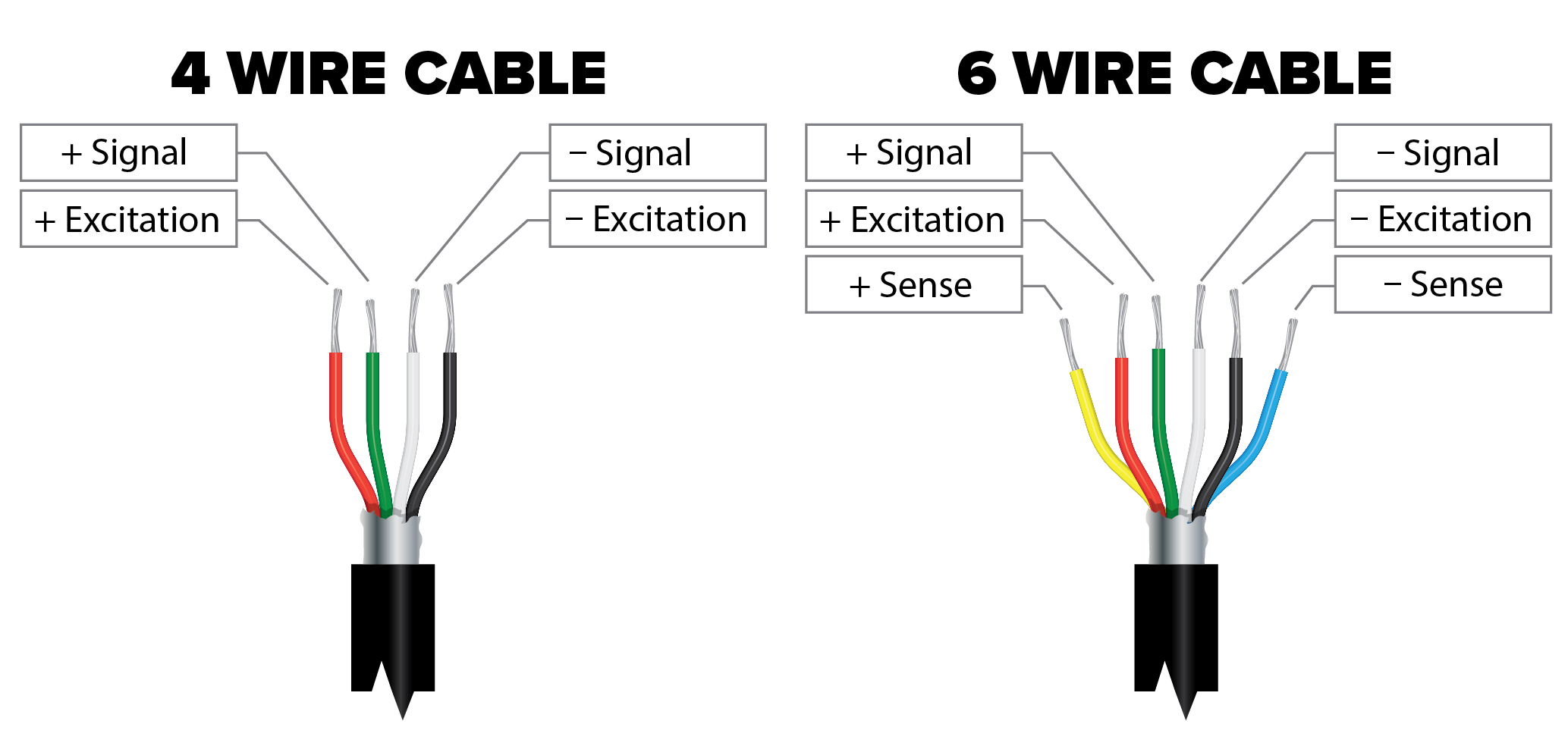
Load Cell Wire Color Codes
Wire colors identify each line at a glance, but they're not standardized across manufacturers. A red wire in one brand's load cell may serve a completely different function in another brand's. Before making any connections, always pull the wiring guide for the specific load cell you're working with — not a generic chart.
Rice Lake Weighing Systems offers an online load cell wiring guide that technicians can reference during installation and troubleshooting.
SellEton's load cell kits include clear documentation so installation doesn't require guesswork. Browse our NTEP-certified shear beam load cell kits — available in capacities for floor scales, hoppers, tanks, and more.
What Is Load Cell Trimming?
A typical floor scale has four load cells, one under each corner. In theory, each one should carry exactly one-quarter of any load placed on the platform. In practice, that never happens perfectly.
Weight distribution shifts based on where a load sits, how level the floor is, and how the scale's structure transfers force to each foot. Load cells themselves come out of manufacturing with slight output differences — two cells with the same part number won't behave identically under load. If those differences aren't corrected, the scale's reading depends not just on the weight of the load, but on where it's placed on the deck.
Trimming fixes that. The signals from each load cell are brought together in a junction box, where adjustments are made to balance the outputs before sending a single summed signal to the indicator.
In tank filling, vessel loading, or hopper batching, this matters even more. Agitators, asymmetric material flow, and uneven buildup can all shift how weight reaches each load cell. Untrimmed systems in those applications don't just read inaccurately — they compound errors over time.
Types of Load Cell Trimming
Trimming happens at the junction box. There are two methods, each with a different approach to getting all cells to agree.
Excitation Trimming
The older of the two methods. Excitation trimming reduces the supply voltage to individual load cells by adding resistance to their excitation circuits. The cell with the lowest natural output becomes the reference — all others are brought down to match it.
Field steps:
-
Verify individual cell capacity ratings
-
Inspect all wiring for damage or loose connections
-
Apply a test weight over each load cell individually
-
Identify the cell with the lowest reading; adjust all others down to match
-
Confirm accuracy with a full-scale test weight
The downside: resistance values shift with temperature. Excitation trimming can drift over time in environments with significant temperature swings, requiring periodic rechecks.
Signal Trimming
The more common method today is compatible with nearly all indicators. Instead of altering supply voltage, signal trimming adds a high-resistance parallel path across each load cell's signal output. This bleeds off a controlled portion of the signal — the higher the parallel resistance, the more signal reaches the indicator; lower resistance bleeds more off.
The same reference logic applies: find the lowest-output cell, trim everything else down to match using the junction box potentiometers.
Field steps:
-
Configure jumpers and potentiometers for active cells; disable unused positions
-
Apply a test weight over each cell individually
-
Adjust potentiometers to match the lowest reading
-
Verify with a final test weight
Signal trimming holds up better under temperature variation and vibration, which is why it's become the default for most installations.
When Your Scale Is Out of Trim
A properly trimmed scale reads the same regardless of where the load sits on the platform. When that's no longer true, it shows up in a few specific ways: readings that shift when a load is moved from corner to corner, zero drift that wasn't there before, or a scale that passes calibration at the center but fails at the edges.
Those symptoms don't always mean a full-service call. Sometimes a cable has been nicked, a connection has corroded, or a load cell has started to fail on one corner. Knowing what trimming is — and what it affects — puts you in a position to describe the problem accurately rather than just reporting that the scale "seems off."
Ready to Upgrade or Replace Your Load Cells?
If your scale is giving inconsistent readings, drifting off zero, or failing corner tests, the load cells or wiring are usually where you start.
Shop Load Cell Kits at SellEton → Call (844) 735-5386 or email info@selletonscales.com